
























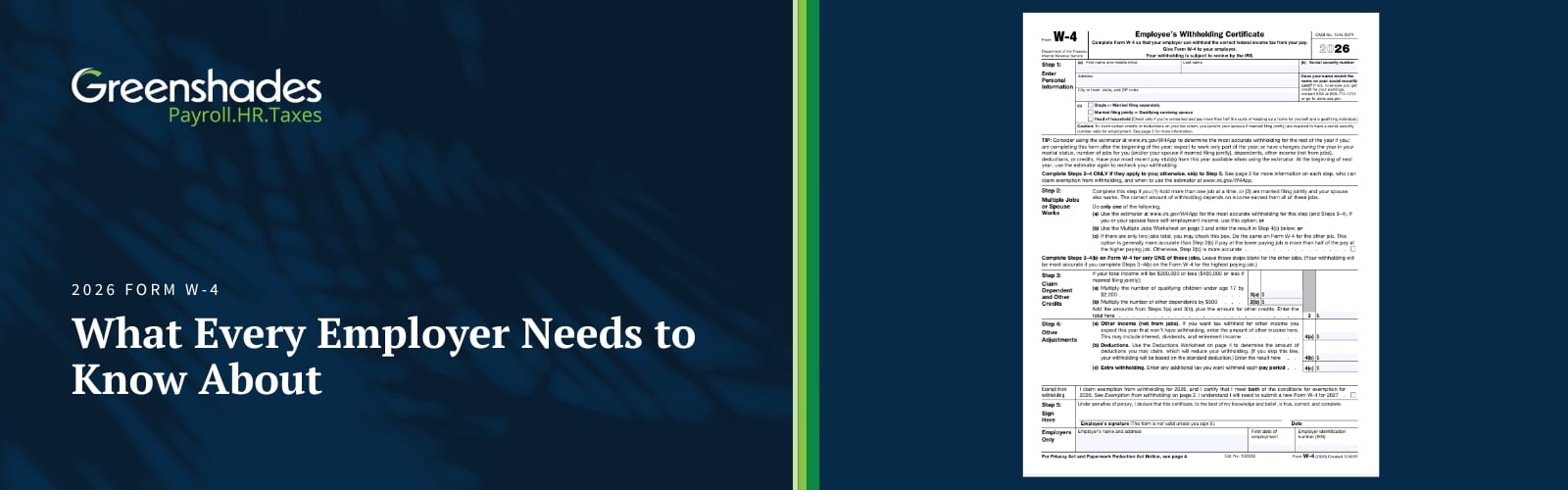
With the release of the 2026 Form W-4, employers must understand the latest updates to ensure accurate federal income tax withholding for their workforce. While the form maintains the familiar five-step structure introduced in the 2020 redesign, several figures and worksheets have been updated for 2026.
Staying informed about these changes is essential for maintaining a compliant and efficient payroll process. This guide outlines what’s changed on the 2026 Form W-4 and what employers should do to remain compliant.
⚠️Note: This information is for informational purposes only and does not constitute formal tax, legal, or compliance advice. Always consult with qualified tax advisors, legal counsel, and your organization’s internal teams for guidance specific to your situation. Additional regulations may apply. For the most accurate and up-to-date information, refer to official government resources and regulatory agencies.
Overview of the 2026 Form W-4
The 2026 Form W-4 continues to use the five-step layout introduced in 2020, which moved withholding calculations away from allowances and toward a more precise method based on income, dependents, and deductions.
While the layout remains the same, the IRS has updated specific figures on the form to reflect inflation adjustments and changes reflected in the 2026 tax year. The most notable updates include:
Revised Standard Deduction Amounts
Step 4(b) (Deductions Worksheet) and the accompanying tables have been updated to reflect the 2026 standard deduction amounts.
| Filing Status | 2026 Standard Deduction |
|---|---|
| Single | $16,100 |
| Married Filing Jointly | $32,200 |
| Head of Household | $24,150 |
Source: IRS inflation adjustments for TY 2026 (including amendments under the One, Big, Beautiful Bill)
These updated amounts affect how employees calculate expected deductions and, in turn, their withholding.
Updated Step 3 Dependent Credit Amount
In Step 3, the 2026 Form W-4 instructs employees to multiply the number of qualifying children under age 17 by $2,200 when calculating their dependent credits. Accurate completion of this step helps ensure appropriate reductions in federal income tax withholding.
*Note: If the dependent reaches 17 during the calendar year, they will not qualify for the Child Tax Credit at all.
Expanded Deductions Worksheet
The Deductions Worksheet (Page 4) of the 2026 Form W-4 includes new, clearly labeled lines allowing employees to account for total expected annual deductions related to:
- Qualified tips
- Qualified overtime compensation
- Qualified passenger vehicle loan interest
These additions allow employees to more precisely estimate deductions when completing Step 4(b).
Senior Standard Deduction Lines
The worksheet also includes specific lines (3a and 3b) for employees age 65 or older to account for the additional standard deduction amount of $6,000, subject to applicable income thresholds.
You can view and download the official IRS form here: 2026 Form W-4 (PDF).
Key Compliance Considerations for Employers
When integrating the 2026 Form W-4 into your payroll processes, employers should focus on three primary compliance areas.
1. Updated Withholding Tables (Publication 15-T)
Form W-4 must be used alongside the correct withholding tables found in IRS Publication 15-T, Federal Income Tax Withholding Methods, which provides both the percentage method and wage bracket method calculations.
For 2026, employers must ensure their payroll systems are updated with the 2026 Publication 15-T tables. Using outdated tables will result in incorrect withholding calculations, even if an employee submits an accurate Form W-4.
Note for payroll teams:
- If you use an automated payroll provider, confirm that the 2026 Publication 15-T tables have been implemented.
- If you calculate payroll manually, be sure you are using the correct worksheet based on whether the employee’s Form W-4 is from 2020 or later, or from 2019 or earlier.
2. Handling Exemption Claims
Employees who want to claim exempt from federal income tax withholding for 2026 must submit a new Form W-4 each year to maintain that status.
The deadline:
Employees must submit a 2026 Form W-4 claiming exemption by February 16, 2027.
If they miss the deadline:
If an employee does not submit a new exempt Form W-4 by this date, employers must begin withholding federal income tax as if the employee checked “Single or Married filing separately” in Step 1(c) and made no entries in Steps 2, 3, or 4.
How exemption is claimed:
To claim exemption for 2026, the employee must certify that:
- They had no federal income tax liability in 2025, and
- They expect no federal income tax liability in 2026
The employee must indicate this by checking the “Exempt from withholding” box located below Step 4(c) on the 2026 Form W-4.
3. New Hire Requirements
For employees hired in 2026, employers should provide the current-year Form W-4 (2026) during onboarding. If a new employee submits a Form W-4, it must be the current revision.
If a new hire fails to furnish Form W-4, the employer must withhold federal income tax as if the employee checked “Single or Married filing separately” in Step 1(c) and made no entries in Steps 2 through 4.
Managing Existing Employees and W-4 Updates
A common misconception is that all employees must complete a new Form W-4 every year. This is not the case.
Who Needs to Submit a New Form?
Existing employees are not required to submit a new Form W-4 simply because the year has changed. Employers should continue withholding based on the valid Form W-4 already on file, even if that form is from 2019 or earlier and uses allowances.
However, employers should encourage employees to review and update their withholding if:
- Their personal or financial situation has changed (e.g., marriage, divorce, birth of a child, or a second job)
- They owed a large balance or received a significant refund when filing their 2025 tax return
- They want to adjust withholding to reflect the 2026 tax brackets or standard deduction amounts
The “Computational Bridge”
For employees with a 2019 or earlier Form W-4 on file, the IRS provides a “computational bridge” in Publication 15-T. This allows payroll systems to translate allowance-based data into the modern withholding calculation without requiring the employee to submit a new form.
Best Practices for Payroll Teams
To support compliance and employee confidence, payroll teams should consider the following best practices:
- Communicate early: Remind employees that tax season is a good time to review withholding and that the 2026 Form W-4 is available if changes are needed.
- Promote the IRS Tax Withholding Estimator: Encourage employees to use this tool, especially if they have multiple jobs, dual incomes, or complex tax situations.
- Review payroll systems: Confirm that updated deduction lines and credit amounts (such as the $2,200 qualifying child amount) are properly configured.
- Manage nonresident aliens carefully: Nonresident aliens generally cannot claim the standard deduction and must follow special instructions outlined in IRS Notice 1392. Ensure your system applies the required “add-to-wages” adjustment where applicable.
Keeping Compliance Simple
Managing payroll compliance requires close attention to annual IRS updates. By ensuring your payroll systems are aligned with the 2026 Publication 15-T tables and by understanding the specific updates to the 2026 Form W-4, employers can help ensure accurate withholding and a smooth transition into the new tax year.
For complex withholding scenarios, consult IRS Publication 15 (Employer’s Tax Guide) or a qualified tax professional.