




















For most payroll teams, the goal is the same: run payroll on time, minimize errors, and keep everything as electronic as possible. What doesn't always make it into that conversation is what happens on the other side — when a portion of your workforce can't receive those wages the way you want to deliver them.
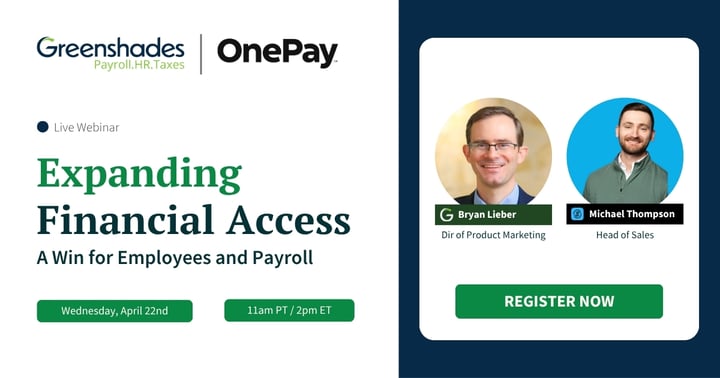
That's the problem Bryan Lieber (Dir. of Product Marketing, Greenshades) and Michael Thompson (Head of Sales, OnePay) unpacked in this live webinar. Using real data and a practical framework, they walked through the scale of banking access gaps in the U.S. workforce, what it costs both employees and payroll teams to operate without a solution, and how embedding financial tools directly in the payroll experience changes the equation.
This recap includes:
- The hidden payroll challenge
- Scale of the problem — by the numbers
- The impact on employees and payroll teams
- Expanding financial access with OnePay
- A practical roadmap for payroll leaders
- Q&A
You can watch the full session here:
The hidden payroll challenge
Your team works hard to run a tight payroll. But there's a piece of that equation you may not fully control: a portion of your workforce can't receive their pay electronically — because they don't have a bank account.
That gap creates three distinct problems for your organization.
-
The operational drag: Every paper check means additional manual steps — printing, signing, distributing, tracking, and sometimes reissuing when checks are lost. That's time and cost that doesn't show up on a single line item, but it adds up fast.
-
The fraud surface: Paper checks are the most fraud-prone payment method in existence. A check contains everything a bad actor needs: account number, routing number, an authorized signature. The Financial Crimes Enforcement Network reported over 680,000 check fraud incidents in 2022 alone — and a 2023 follow-up found mail-theft-related check fraud was tied to more than $688 million in transactions.
-
The employee burden: Workers without bank accounts often have to visit check-cashing outlets just to access wages they've already earned, paying fees for the privilege. Even employees who do have bank accounts are often getting hit with overdraft fees, late fees, and high-interest credit products that keep them in a cycle of reactive financial decisions.
The key insight: these aren't separate problems. They're connected. Solving financial access for employees also solves operational problems for payroll teams.
Scale of the problem — by the numbers
According to the FDIC's most recent household survey, the scope of this issue is larger than most employers realize.
- 5.6 million U.S. households are fully unbanked — no checking account, no savings account, nothing in the traditional banking system
- 19 million households are underbanked — they may have an account, but still rely on services like check-cashing outlets, payday loans, or money orders regularly
- 1 in 5 American households falls into one of these two categories
These rates are significantly higher in industries with large hourly or seasonal workforces: staffing, hospitality, construction, agriculture, retail, and transportation — the same industries Greenshades serves.
Beyond unbanked and underbanked, there's a third category worth naming — not properly banked. These are employees who technically have an account, but it's not actually working for them. Fees erode their balances, savings yields are near zero, and there's no path to credit-building or financial stability. The numbers back this up: 77% of working Americans report living paycheck to paycheck, and an unexpected $400 expense is enough to push many into a debt spiral.
This isn't a fringe issue. It's a mainstream workforce challenge.
The impact on employees and payroll teams
The friction shows up on both sides.
For employees
Check-cashing fees typically run 2–3% of the face value of a check. For someone earning $800 per week, that's up to $24 per paycheck before they've paid a single bill — and more than $600 a year in fees just to receive wages they've already earned. Without a bank account, there's no easy way to set up automatic bill payments, build a savings buffer, or qualify for affordable credit.
Financial stress follows. Research from PayrollOrg found that 77% of workers say they'd struggle to meet obligations if their paycheck was delayed by even one week.
For payroll teams
Paper checks cost $2–$4 each to issue, compared to roughly $0.40 for ACH direct deposit. For a company with 100 employees on paper checks running bi-weekly payroll, that's potentially $10,000 or more in direct processing costs annually — before accounting for staff time spent on distribution, tracking, and reissuance. Add fraud risk on top of that, and the case for reducing paper check volume becomes very concrete.
Why employees stay outside the banking system
Before you can solve this problem, it helps to understand it. Most unbanked workers aren't opposed to banking — they're running into structural barriers that make the traditional system inaccessible or unappealing.
According to the same FDIC survey, the top reasons unbanked workers don't have a bank account — even among those who say they're interested in having one — include:
- Minimum balance requirements (46.6%) — particularly difficult for workers with seasonal or irregular income
- Bank account fees are too high (30.5%)
- Don't trust banks (27.2%)
- Fees are too unpredictable (25.8%)
The trust dimension is worth sitting with. For workers who've experienced unexpected account closures, accumulated bank debt, or been put on a list that makes opening a new account nearly impossible, skepticism isn't irrational — it's earned. Solving this isn't just about products. It's about meeting employees with tools they can actually trust.
Expanding financial access: where OnePay fits
Financial wellness isn't solved by a single benefit. It's a journey — and most employees are at very different starting points. There are four stages of that journey:
-
Stabilize — employees who are getting by but feel financially fragile. They need liquidity, overdraft protection, fee-free banking, and the ability to access their paycheck a day or two early.
-
Build — employees ready to start saving and building credit. They need emergency savings tools, personal savings accounts, credit-building products, and financial coaching.
-
Grow — employees planning ahead and working on long-term credit optimization. They need credit monitoring, a line of credit, and financial planning support.
-
Empower — employees who are financially confident and focused on wealth creation. They need 401(k) tools, rewards on spending, and asset-building resources.
The key insight: payroll is often the most consistent touchpoint employers have with their workforce. It's where money enters the system — and it's naturally where this journey can begin.
What traditional banks aren't doing
The banking comparison from the session made a stark point. Across major banks, overdraft fees to access $100 range from $20 to $35, annual maintenance fees run as high as $144, savings APY sits between 0.01% and 0.25%, and credit-building tools and debit rewards simply don't exist. Traditional banking products were largely built for people with stable income and consistent balances — not for the hourly and shift-based workers who make up a significant portion of the American workforce.
OnePay in the Greenshades experience
For Greenshades customers, OnePay is built directly into the Green Employee portal. When employees go to view their most recent pay statement, they see an option to sign up for OnePay — a short, simple enrollment process that connects directly to their direct deposit setup.
- No cost or administrative lift for the employer
- No new vendor to manage, no workflow changes, no IT project
- Enrollment is embedded where employees already are — high-intent placement at the moment they're thinking about their pay
- Once enrolled, employees have access to fee-free banking, 2-day early pay, industry-leading APY on savings, a fee-free credit builder, overdraft protection, and access to 55,000+ ATMs
The integration was intentional about one thing in particular: it's completely optional. No one is forced into a banking relationship. The goal is to make sure employees know the option is there, in the moment it's most relevant.
A practical roadmap for payroll leaders
The session closed with five concrete steps for payroll leaders who want to move from awareness to action.
01 — Understand your current payment mix. Pull a report on how many employees are on paper checks vs. direct deposit. This quantifies the real cost (check cost × volume × pay periods per year) and gives you a benchmark to measure improvement against.
02 — Identify why employees aren't on direct deposit. Don't assume. Survey employees or work with HR to understand the actual barriers. An employee who's never been prompted to set up direct deposit needs a different solution than an employee who doesn't have a bank account. Don't solve a problem you haven't diagnosed.
03 — Offer accessible financial tools and payment options. If the barrier is lack of a bank account, direct deposit alone isn't the answer. Consider solutions designed for workers who've been underserved by traditional banking — modern, low-fee, mobile-native options that don't require a clean banking history to access.
04 — Embed enrollment in the payroll experience. Financial tools adopted in isolation rarely stick. When employees can set up a payment method inside the same self-service portal they already use to view pay stubs and W-2s, enrollment rates go up. Friction is the enemy of adoption.
05 — Lead with the employee benefit, not the policy. The internal goal may be to reduce paper check volume — but that's not what motivates employees. Lead with what they gain: no more check-cashing fees, faster access to their wages, easier day-to-day money management. When the communication is employee-first, the adoption follows.
Q&A
| Question | Answer |
|---|---|
| Do we have to have the payroll module in Greenshades to use OnePay, or is it available for all Greenshades customers? | If you're using Greenshades payroll, HR, or tax products, you should have access. Reach out to your Greenshades contact to confirm your setup. |
| This feels like it's aimed at unbanked employees — what about workers who already have bank accounts? | Financial access isn't just about whether someone has an account — it's about whether that account is actually working for them. Plenty of employees have a checking account but are still living paycheck to paycheck, carrying high-interest debt, or have no savings buffer. The goal is giving every employee better options around their pay, regardless of where they are in their financial journey. |
| How does OnePay compare to pay cards and earned wage access products? | Pay cards and earned wage access both play a role in financial wellness, and OnePay is designed to complement rather than replace those tools. The difference is breadth: OnePay covers the full financial journey — savings, credit-building, rewards, and more — rather than solving a single use case. |
| How is OnePay different from Chime/CashApp in terms of user safety? Many employees are leery that fintech companies are easier to hack info. | At OnePay, security is embedded across the entire customer lifecycle to protect data and keep accounts safe from fraud. We combine strong backend controls like multi-factor authentication with simple, real-time tools such as card locking, alerts, and spending tracking. The goal is to make security both reliable and easy to manage every day. |
| Can't my employees just sign up for OnePay on their own? | They can — OnePay is available directly to consumers (it has a significant presence through Walmart, one of its major investors). But the value of the Greenshades integration is timing and context. Meeting employees in the platform where they're already viewing their pay stub — at the exact moment they're thinking about their money — is what drives adoption. That's harder to replicate when the tool lives somewhere else. |