
























In this issue, we highlight compliance developments that may affect payroll, tax, and reporting obligations, along with Greenshades resources that can help your organization prepare, file, and respond with confidence.
Compliance updates and year-end support
Preparing for year-end filing
Year-end filing can be demanding. Greenshades is preparing tools and resources to help streamline each stage of the process.
Your review remains essential. Please verify imported data, monitor filing progress, and confirm that each return has been successfully submitted.
Supported returns and filing options
Greenshades Software Inc. is authorized to transmit supported IRIS returns, including Forms 1098, 1099, 1042-S, and W-2G. Greenshades is also approved to submit ACA returns and federal W-2 e-files.
The Year-End Forms portal supports these and other forms and provides Excel templates to help you import data efficiently. The portal also includes an easy-to-follow wizard that guides you through formatting, filing, and distribution options.
Electronic filing mandate
If you file more than 10 federal information returns in aggregate for an EIN, federal rules generally require all covered returns for that EIN to be filed electronically.
Regulatory updates at a glance
- Effective July 6, 2026, Minnesota enacted Earned Sick and Safe Time rules.
- Minneapolis, Minnesota, updated its Earned Sick and Safe Time requirements to align with state changes effective July 6, 2026.
- Colorado will introduce state-level EEO-1 reporting effective July 1, 2027.
- Effective January 1, 2027, Massachusetts Paid Family and Medical Leave deductions will change for employers with 25 or more employees.
- Effective July 15, 2026, New York State employers with 15 to 29 employees that do not offer a qualified retirement plan must register for the state’s Secure Choice Savings Program.
- Georgia is conforming to OBBBA provisions for qualified tips and overtime. Tax year 2026 forms will not require detailed reporting; tax year 2027 forms will be revised to capture this information.
- Vermont unemployment services transitioned to the Employer e-Services portal on July 20, 2026.
- Virginia unemployment services moved to the VEC Employer Self-Service portal on August 1, 2026. The portal uses ID.me for sign-in.
- Florida consolidated reemployment tax filing and payment options on a single website. Select “Reemployment Tax – Agent, Employer, and Leasing” to access the available file formats.
- On July 27, 2026, Michigan unemployment services (MIUI) added multifactor authentication to the sign-in process.
- West Virginia reduced its withholding tax rate retroactive to January 1, 2026.
- Ohio updated its withholding tax rates and tables effective August 1, 2026.
- Effective June 3, 2026, Colorado employers may not retain, demand, or require an employee to surrender a government-issued identification card. An employer may temporarily retain the card for fewer than 10 hours to verify employment eligibility and may copy it only when required by state or federal law. See HB 1283.
- Maine updated its 2026 withholding tax tables to reflect the 2% surcharge and revised standard deductions.
- Maryland FAMLI payroll deductions begin January 1, 2027. From September through November 15, 2026, employers must file a declaration stating whether they will participate in the state plan or obtain a private plan.
- San Francisco, California, reduced the service requirement for Paid Parental Leave eligibility from 180 days to 90 days.
- Virginia is also transitioning employer withholding services to a new Taxpayer Access Point (TAP) website, with launch scheduled for November 9, 2026.
- On September 1, 2026, Puerto Rico launched a new portal for unemployment filings, Desempleo Digital.
- Pennsylvania Department of Labor & Industry announced “Standing Up for Home Care Workers,” a statewide enforcement initiative focused on ensuring home-care workers receive all wages and overtime owed under Pennsylvania law. Greenshades reports can help support your response if your organization is selected for review.
- Social Security Administration: SSA plans to replace the current Business Services Online sign-in process with Management of Authorization for Government Users, Institutions, and Customers (MAGIC). A launch date has not yet been announced.
Q3 2026 quarter-end processing begins Thursday, October 1, 2026.
USPS postmark guidance for tax return mailings
As year-end approaches, employers should be aware of U.S. Postal Service guidance that may affect how mailing dates are documented for tax statements, tax returns, and other time-sensitive documents. This guidance is also relevant throughout the year whenever tax returns or related correspondence must meet required filing, mailing, or recipient distribution deadlines. Many agencies rely on the postmark date to determine whether a filing or recipient distribution requirement was met by the applicable deadline.
Greenshades offers year-end print and mail services on a sliding fee schedule. Processing forms earlier can help reduce mailing costs and provide additional time to meet distribution deadlines. Delaying print and mail requests, whether completed through Greenshades or internally, may increase the risk that statements do not receive a postmark date that supports timely distribution.
The U.S. Postal Service has clarified that automated postmark dates may reflect when mail is first processed at a regional facility, rather than the date the item was placed in a collection box or dropped off. For mailings tied to strict deadlines, clients should consider requesting a manual “round-date” postmark at a USPS retail counter.
What changed
- Automated postmarks may not reflect the drop-off date. Mail may receive an automated postmark when it is first processed by USPS equipment, which can occur after the item is deposited or collected.
- Processing timelines can vary. Mail routing, regional processing, and transportation schedules may affect when an item receives an automated postmark.
- Manual postmarks remain available. For mailings where the postmark date is important, clients may request a manual postmark from a USPS retail clerk at the time of mailing.
Recommended client actions
- Plan deadline-sensitive mailings early. Allow sufficient time for printing, mailing, and USPS processing before applicable year-end, filing, or recipient distribution deadlines.
- Use a manual counter postmark when needed. For documents subject to strict mailing deadlines, present the mail at a USPS retail counter and request a manual same-day postmark.
- Consider trackable mailing options. Certified Mail, Registered Mail, or other USPS services may provide additional documentation of mailing activity when proof of timing is important.
Hawaii low earnings reports
Hawaii employers must file Form UC-BP-52(a) when an employee’s work hours are reduced because of a lack of work and the employee earns less than the potential weekly unemployment benefit amount.
The report must be filed electronically through the Hawaii unemployment portal. This reporting requirement is time-sensitive and must be completed within five working days after the pay period in which the low earnings occurred.
The report must include the employee’s name, Social Security number, gross earnings for the pay week in which the low earnings occurred, and the reason for the low earnings.
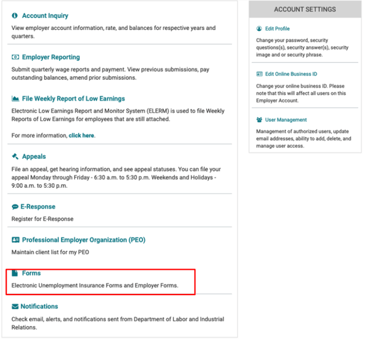
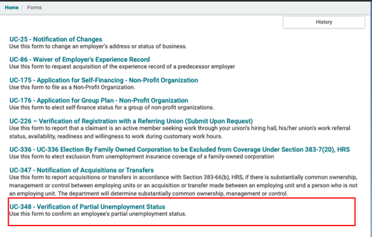
Employers must also file Form UC-348, Verification of Partial Unemployment Status, within five working days after an employee files a claim for partial unemployment benefits. This form is also submitted electronically through the Hawaii unemployment portal. See the next column for where to locate the form.
Once the form is submitted, the employer will receive a confirmation email. Amendments cannot be made through the portal; however, employers may contact the local office to correct a submitted form.
Employers should review the contact information on file to ensure the appropriate employee receives notifications and has the necessary portal access to complete the required reporting.
Department of Labor proposed rulemaking on joint employers
On April 22, 2026, the U.S. Department of Labor’s Wage and Hour Division published a Notice of Proposed Rulemaking that would revise how the agency evaluates joint-employer status under federal wage and hour laws. The proposal would establish regulatory guidance for determining joint-employer status under the Fair Labor Standards Act (FLSA) and would amend existing regulations under the Family and Medical Leave Act (FMLA) and the Migrant and Seasonal Agricultural Worker Protection Act (MSPA) so the same analysis would apply under those laws.
The proposal is significant because a joint-employer finding may make one business responsible for workers formally employed by another entity. Employers that use staffing agencies, contractors, franchise models, agricultural labor contractors, professional employer organizations, management-services companies, or affiliated entities should pay close attention to the proposed standard.
Key points
Unified Standard and Vertical Joint Employment. The proposed rule would restore FLSA joint-employer guidance at 29 CFR part 791 and use that analysis under the FMLA and MSPA. “Vertical” joint employment generally involves a worker who is employed by one business, such as a staffing agency or subcontractor, while performing work that benefits another business that may direct or control aspects of the work. For these relationships, the proposed rule focuses on whether the potential joint employer:
- Has the authority to hire or fire the worker;
- Supervises or substantially controls the worker’s schedule or working conditions;
- Determines the worker’s rate and method of pay; or
- Maintains the worker’s employment records.
Reserved Control. The analysis would not be mechanical. Additional facts may be relevant, and when all four factors point in the same direction, there is a substantial likelihood that joint-employer status either exists or does not exist. The DOL would consider both reserved and exercised control, although exercised control would generally carry more weight.
Horizontal Joint Employment. “Horizontal” joint employment generally involves the same employee working for two or more separate businesses in the same workweek, such as related businesses or businesses that coordinate employment decisions. The key question is whether the businesses are sufficiently connected with respect to that employee’s work. Ordinary business relationships, such as sharing a vendor or common franchisor, generally are not enough by themselves.
Steps for employers to consider
- Map relationships and control points. Identify staffing, subcontracting, franchise, PEO, management-services, agricultural labor contractor, and affiliated-company arrangements. Note which entity hires, fires, schedules, directs work, sets pay, maintains records, and handles leave.
- Align contracts with actual practice. Contract provisions that reserve rights to supervise, discipline, schedule, set pay, or control working conditions should reflect how the relationship operates in practice and should be retained only when they serve a legitimate business need.
- Reduce unnecessary day-to-day control. Route performance, attendance, scheduling, and discipline concerns through the contracting entity rather than managing another company’s employees directly.
- Update manager guidance. Train supervisors on when communications with contractor, staffing, or other third-party workers could create joint-employer risk.
Exempt vs. non-exempt employees: salary threshold update
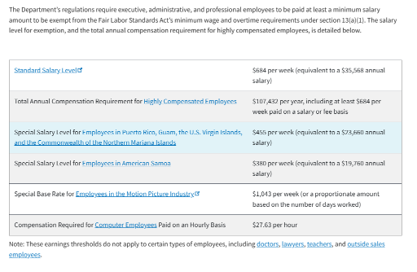
The U.S. Department of Labor’s Wage and Hour Division announced a technical amendment to update the salary-level regulations in Part 541 of Title 29. The amendment removes provisions vacated by federal courts, including the 2024 salary thresholds, and restores the 2019 levels used to determine whether certain executive, administrative, and professional employees may qualify as exempt from minimum wage and overtime requirements under the Fair Labor Standards Act.
- Restored salary threshold: $684 per week.
- Highly compensated employee threshold: $107,432 per year.
- Current enforcement position: The amendment does not change the Wage and Hour Division’s current enforcement approach because the agency has applied the 2019 thresholds since the 2024 rule was vacated in November 2024.
Tips paid by credit card
When a customer pays by credit card, they may add a tip to the transaction. Because credit card payments generally include processing fees, employers should confirm whether those fees may be deducted from the employee’s tip before payment.
States that require full tip payment
Some states require employers to pay the full tip amount to the employee before deducting any credit card processing fees. These states include California, Delaware, Maine, Massachusetts, Minnesota, New Jersey, and Pennsylvania.
Federal baseline rule
Most states follow the federal Fair Labor Standards Act, which permits employers to deduct the processing fee from the tip portion only if all of the following conditions are met:
- The deduction is based on the actual processing fee, not a rounded-up estimate.
- The deduction applies only to the tip portion, not the full sale amount.
- The employee’s total wages do not fall below the applicable minimum wage.
State-specific nuances
Several states have additional requirements or unresolved treatment for credit card processing fee deductions:
- New York: Deductions are permitted as long as the employee’s total compensation meets minimum wage requirements.
- Texas: Employers must obtain written employee authorization before making the deduction.
- Washington: Effective July 1, 2026, pending legislation will prohibit fee deductions.
Kentucky and Montana: These states do not specifically address whether processing fee deductions are permitted.
Davis-Bacon updates: past year
Contractors on federally funded construction projects should note these Davis-Bacon updates:
Minimum wage: The separate $17.75/hour federal contractor minimum wage was rescinded in March 2025, but Davis-Bacon prevailing wage and fringe rules still apply.
WH-347: The revised certified payroll form, effective January 2025, adds fringe benefit and apprenticeship reporting; the prior form may be used through September 30, 2026.
Penalties: Civil penalties now exceed $13,500 per violation after inflation adjustments.
2026 wage determinations: DOL updated rates across many counties, so contractors should verify each project location.
Next steps: Review policies against the 2023 rule, prepare for the new WH-347, verify wage determinations, and confirm apprenticeship documentation before the 2026 deadline.
Summary of changes to supported year-end forms
- W-2/W-2 – Box 14a and 14b (two separate sections)
new Box 12 codes: TA – Trump Accounts, TP – Total Cash Tips, TT – Qualified Overtime, and P – now includes the intelligence community - 1042-S – new field 7d – Additional withholding payment data for US source income paid to foreign persons and a chapter 3 code is now required in all cases where the tax withheld is less than 30%
- 1099-MISC/NEC – new boxes 13a – Cash Tips, 13b - TTOC codes (two separate sections), and 14 – overtime compensation
- 1098-T – years in boxes 1 and 7 have been updated for TY2026 reporting
- 1099-B – dates have been updated in boxes 8, 9, and 10
- 1099-K – new boxes for reporting cash tips and the TTOC (two separate sections)
- 1099-R – New boxes 7a and 7b were renumbered, 7c – Trump Accounts, 7d – Earnings on excess contributions, Box 8 is not broken into 2 sections 8a and 8b.
Added Code Y – reports qualified charitable contributions. - 1099-S – now includes using digital assets to purchase real estate.
Box 2 is not 2a – Cash Gross Proceeds and 2b – Digital Assets Gross Proceeds, New Boxes: 8a – Digital Asset code, 8b – Digital Asset Name, 8c – Number of Digital Assets used, and 8d – date of transaction - W-2G – Minimum Thresholds have changed:
- Slots and Bingo from $1,200 to $2,000
- Keno from $1,500 to $2,000
- Sports Wagering from $1,200 to $2,000
- Horse Racing, Dog Racing, Jai Alai & Other Wagering from $600 + 300x odds to $2,000 + 300x odds
- Lottery Winnings from $600 + 300x odds to $2,000 + 300x odds
- Poker Tournaments $5,000 (unchanged)
Recent IRS guidance
Notice 2026-48, Notice of Intent to Issue Regulations with Respect to Saver’s Match Contributions
IR-2026-88 — Updated frequently asked questions on the deduction for qualified overtime compensation.
The updated guidance appears in Fact Sheet FS-2026-13 and revises Fact Sheet FS-2026-01, issued in January 2026.
Notice 2026-80, Trump Accounts Safe Harbor
More from Compliance Corner
- Perfecting Quarter-End Payroll Tax Reporting (Form 941)
- How to Make the Most of National Payroll Week
- Webinar Recap: How to Get Job and Client Cost Data Directly from Payroll
- What IRS Letter 226-J Means for Your ACA Compliance Records
- Four ERISA Guardrails for Trump Account Contributions: What HR Needs to Know
- The IRS Assigned a W-2 Code to Trump Account Employer Contributions: What It Means for Payroll
- Midyear Compliance Rundown: Watch the Recording
- How the 280E Transition Affects Cannabis Payroll Records and Labor-Cost Documentation
- Your Midyear Payroll Health Check
- QuickBooks Is Now Automatically Filing Your Payroll Taxes: What That Actually Means
Connect with us in the Compliance Corner LinkedIn group.
Explore more updates in Compliance Corner.
Note: This information is for informational purposes only and does not constitute formal tax, legal, or compliance advice. Always consult with qualified tax advisors, legal counsel, and your organization's internal teams for guidance specific to your situation. Additional regulations may apply. For the most accurate and up-to-date information, refer to official government resources and regulatory agencies.